

Introduction
Ceramic and Tile Slurries utilize dispersants created from acrylic resins to increase the rheological (flow) properties of ceramic slurries. Dispersants create a uniform distribution of particles in the ceramic slurry, which prevents agglomeration and flocculation of the particles. By improving the viscosity of a ceramic slurry and increasing flowability, they allow for better flow during ceramic tile production and improving efficiency for forming, as well as, the operations of producing ceramic tiles. Recently, water-soluble acrylic-based polymers have been classified as the best-performing dispersants for tile and ceramic slurry applications, allowing for exceptional abilities in dispersing, maintaining stability, offering anti-scaling properties, and providing superior rheological performance for ceramic slurries.
The Importance of Acrylic-Based Dispersants in the Ceramic Industry
High solids content and controlled viscosity in a ceramic slip are fundamental to all ceramic manufacturing. Historically, sodium silicate and polyphosphate are the primary dispersants used for particle dispersion in ceramic slips. Although these materials can improve fluidity of a slurry through a sharp rise in pH and provide negative charges on the particle surface, there also disadvantages to their use; e.g., sensitivity to impurities, difficulty in determining optimum dosage, and if overdosed, will increase the viscosity and sludge formation in a slip.
The introduction of acrylic dispersants has changed the way this work is performed. Research has demonstrated that polyacrylate salts (e.g., sodium polyacrylate or ammonium polyacrylate) are highly effective deflocculating agents and control the stability and fluidity of ceramic slips. In comparison to traditional inorganic dispersants, acrylic polymers can provide the same or superior effects while using a significantly lower dosage, and allow for better control of the chemical properties (including pH) of the mixed slip. This means less acrylic additive is needed to achieve the same or better fluidizing effects than were available with many times more sodium silicate or sodium carbonate.
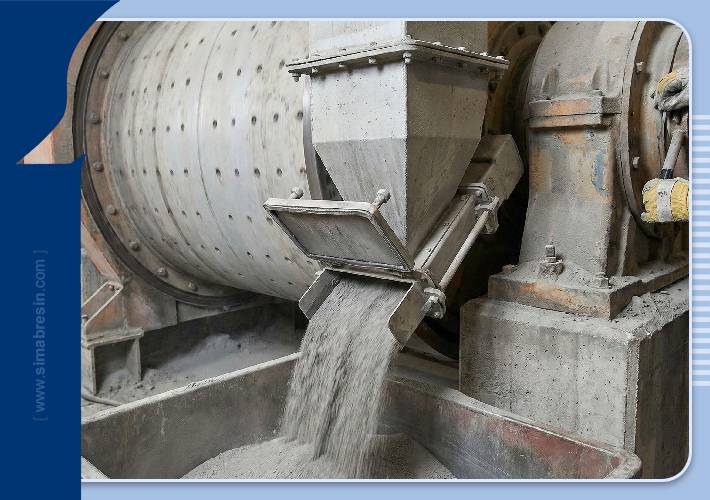
Acrylic dispersants provide an advantage by allowing higher solids loading within a given batch/slurry as well as allowing for an easier exploration of milled solids from ball mills.
When a slurry is added with acrylic dispersants particles have a uniform dispersion and thus there is less space between the particles. Higher solids content in slurries will still be able to have a fluid or workable nature. The result will be that as a consequence of these improvements in slurry flow in the ceramic production lines it will require less water; this will lead to less energy consumption for the spray dryer due to lower drying time, reduced drying defect (drying crack) and higher production throughput. Furthermore, the reduction of sedimentation will allow for easier storage and transportation of slurries when applied on a continuous basis.
Structure and Mechanism of Acrylic Dispersants
Dispersants based on acrylics are commonly found as ionic, water-soluble polymers with a general name of sodium or ammonium polyacrylate. The structure contains a backbone made up of acrylic acid neutralized to form the following type of salts; sodium polyacrylate (i.e., the salt). Each unit in the chain is represented by the general formula –[CH₂–CH(COONa)]ₙ– and they have a number-average molecular weight which can fall between 1,000 and 20,000 g/mol. The principal functional groups of the acrylic polymer chain that provide effective dispersing action are the COO⁻ groups. These COO⁻ groups bind electrostatically to the surface of the suspended particles in a slurry giving the surfaces of the suspended particles a substantial negative charge. The result of the negative charge on the particles causes the particles to repel each other electrostatically preventing them from reflocculating. Scientifically, the electrostatic repulsion causes the zeta potential to be increased for polyacrylate and increases the repulsive force which allows more room for the particles to remain dispersed creating more stable slurry’s and creating slurries that run much more fluid than typical slurries exhibiting Newtonian or pseudoplastic behaviours.
Changed polycarboxylate ethers (PCE) as more advanced acrylic dispersants using comb or branched architectures. Polycarboxylate ether is a type of modified polyacrylate, which contains ether side chains (polyethylene oxide) rather than only a carbon backbone. The presence of non-ionic side chains provides both an electrostatic repulsion and steric hindrance effect that leads to improved dispersion properties compared to linear polyacrylate dispersants. Therefore, the combined effect of the electrostatic repulsion and steric hindrance contributes to the best performance of comb-shaped polycarboxylate dispersants, and enables the user to stabilise very high solids loading at lower polymer dosages than would be offered by linear polymer dispersants. Research indicates that branched polycarboxylates are able to reduce viscosity more effectively than linear polyacrylate dispersants and maintain longer-lasting dispersion stability.
Impact on Slurry Rheology and Flow in Production Lines
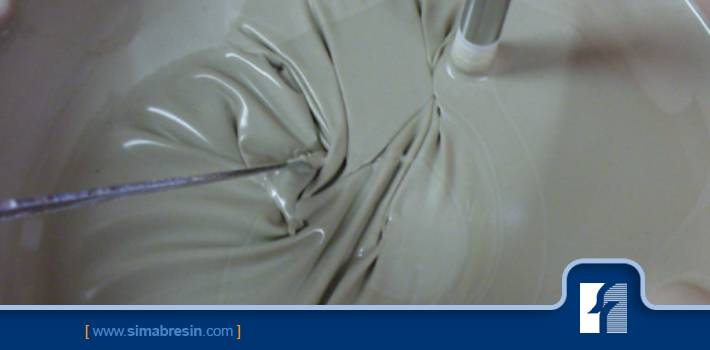
Acrylic dispersants change the overall characteristics of a ceramic slurry’s viscosity behaviour. When polyacrylate is added to the slurry, the viscosity is reduced and the slurry becomes more liquid-like (the “flow-ability” of the slurry). This process of lowering the viscosity of the slurry at low shear rates (e.g., while the slurry is sitting still or is being pumped at a slow rate through a pipe) makes pumping ceramic slurries easier and helps to make the transport of ceramic slurries more uniform. Increased flow-ability through pipes, spray dryer nozzles and shaping equipment makes it far less likely for the ceramic slurry to develop problems such as blockage in pipes, fluctuations in flow rate, or concentrating of solids into a layer on the bottom of the tank.
Acrylic dispersants also have another major effect on ceramic slurries: Reduced sedimentation and phase separation in ceramic slurries. This occurs due to the stable dispersion and ionic stabilization of the ceramic particles so that there are no solid sediment deposits building up at the bottoms of tanks and the slurry is completely homogeneous for long periods of time. This characteristic is necessary for processes where the ceramic slurry is stored or transported for a long distance. A stable suspension ensures uniformity of the slurry properties along the entire assembly line and there is reduced waste of materials as well.
The practical advantages associated with the use of acrylic-based dispersants include both an economic and a technical benefit. The efficiency of wet milling/slurries is improved by reducing the viscosity, preventing the clay paste from adhering to the grinding media or mill walls, thus allowing for better grinding of the particles. Additionally, as mentioned, achieving a higher solids content means that less time and cost is involved in drying the product during the spray-drying processes. Overall, when acrylic dispersants are included in ceramic slurry formulations, the product will be produced at a more consistent level of quality, using less energy, and there will be fewer defects in the final products due to particle segregation and/or entrapment of air.
Comparison of Acrylic Dispersant Types and Their Performance
To clarify the relative performance of different acrylic-based dispersants, the table below summarizes the two main types commonly used in ceramic slurries, along with their mechanisms and advantages:
| Type of Acrylic Dispersant | Polymer Structure & Dispersion Mechanism | Advantages & Characteristics |
| Linear Polyacrylate (Sodium/Ammonium) | Linear polyacrylate chain without side branches; strong electrostatic repulsion generated by adsorbed COO⁻ ions on particle surfaces | Effective viscosity reduction at low dosage; improved slurry stability through increased particle surface charge; suitable replacement for traditional inorganic dispersants (e.g., silicates) due to higher efficiency and easier control |
| Sodium Tripolyphosphate (STPP) | Inorganic sodium tripolyphosphate salt with condensed anionic phosphate structure; releases multivalent anions in water that adsorb onto clay/oxide particles, increasing negative charge and zeta potential, preventing reflocculation, improving dispersion, and lowering viscosity | A well-known, economical deflocculant with strong viscosity-reducing power; enables higher solids loading and improved flow during molding and transfer; reduces sedimentation; suitable for initial formulation optimization although its effectiveness is strongly dosage-dependent and overdosing can increase viscosity and reduce stability |
| Comb-Type Polycarboxylate Ether (PCE) | Modified polyacrylate with ether-based side chains (comb structure); provides electrostatic repulsion plus steric hindrance | Very high dispersing efficiency even at high solids loading; greater viscosity reduction than linear polyacrylates; maintains fluidity over longer periods (high dispersion durability); allows greater water reduction and energy savings by achieving target viscosity at higher solids levels |
The chart indicates that both categories of acrylic materials utilize the same two means of dispersion for both applications; electrostatic repulsion and steric hindrance for comb-type formulations, via their polymeric structure.
As a result of their respective polymeric structures, there exists a difference between the two classes of acrylic dispersants. The latest (next-generation) comb-type polyacrylate dispersants show superior dispersion capabilities for fine-particle systems and high-solids ceramic slurries. Therefore, their use will be dependent upon the individual application; as well as, the specific mineralogy of the mineralogical make-up of the slurry, coupled with availability (or lack thereof) of funding.
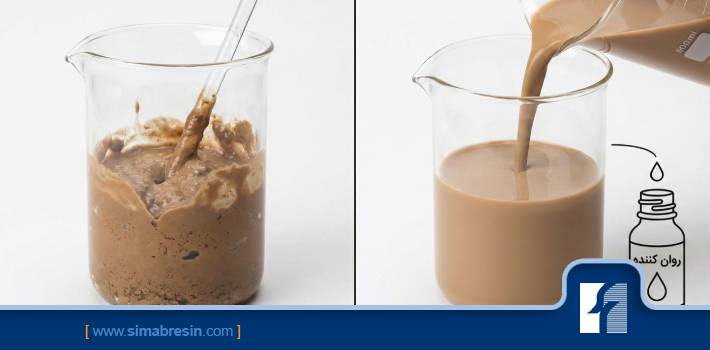
For example, in clay and kaolin slurries consisting of plate-like type particles (having high surface area-to-volume ratio), comb-type dispersants will typically provide superior stability and lower viscosity to slurries.
Conclusion
The development of acrylic-resin-based dispersants is a result of the innovative properties of acrylic resin polymers and has had an enormous impact on the ceramic industry. The addition of polymer-based dispersants to ceramic slurries provides the mechanism by which these additives disperse particles by electrostatic repulsion, thereby enhancing flow, decreasing viscosity, increasing the quality of finished products, removing defects and impurities, and greatly increasing stability at all stages of production. When used at higher concentrations, these polymers also result in improved solids loading, increased product quality, decreased water and energy usage, and improved product quality. Recently published scientific literature has continually supported the advantages of resin-based polyacrymids over inorganic based polymers and has continued to research and develop new resin-based materials (copolymers and modified polymers) for use in ceramics. The increased efficiency of the production of tile is one of the most significant benefits of these materials.
References