

Water-Based Facade Paints
In recent decades, the use of water-based exterior paints as a green, low-odor alternative to oil-based and solvent-based paints has grown rapidly. This trend is largely driven by advances in polymer science and strict restrictions on volatile organic compound (VOC) emissions and environmental pollution. PCI Magazine reports in 2024 that the global market for water-based coatings was worth $68.65 billion in 2023 and is expected to reach $99.16 billion by 2030; this growth is largely driven by increasing environmental regulations and consumer demand for low-odor and low-harm products. In this article, we attempt to explore the benefits of long-lasting, environmentally friendly exterior paints and show why styrene acrylic resins are a smart choice for building facades.
Difference Between Water-Based and Oil-Based Paints on Facades
Differences between water-based and oil-based paints on the facade
Oil-based paints have long been popular for use on building facades due to their durability and high adhesion. However, these paints have some drawbacks: a strong odor, slow drying, the need for toxic solvents for cleaning, and a high VOC content. Better Homes & Gardens explains that oil-based paints create a hard, durable surface, but are not suitable for interior use due to their slow drying and strong odor.
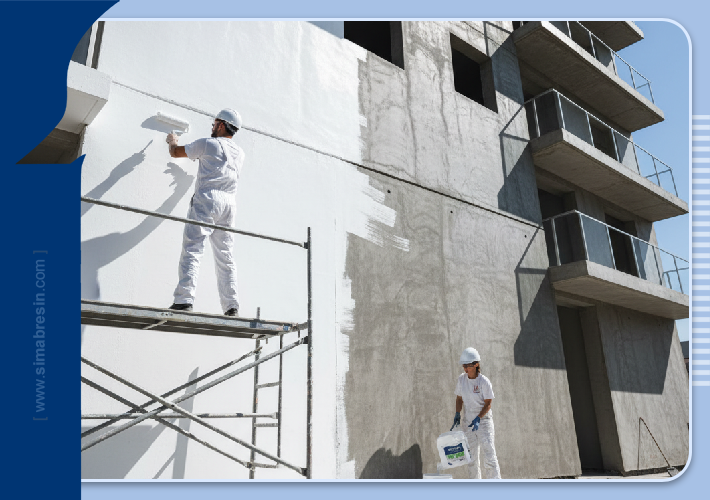
In contrast, water-based or latex paints use water as the main solvent. This structure reduces drying time and the smell of the paint is much less; it also allows you to clean your painting tools with water. Water-based paints are usually odorless and solvent-free, and due to their low VOC, they pose much fewer health and environmental risks than oil-based paints. These features have led most users, especially in residential and urban environments, to turn to water-based paints. Oil-based paints are still used in special situations, such as very old facades or surfaces that require a very hard coating, but modern acrylic and styrene-acrylic resin technology has been able to compensate for many of the traditional weaknesses of water-based paints. According to the Crash of Rhinos Painting article, water-based paints, in addition to their fast drying speed, less odor and low VOC, can be used on surfaces such as plaster, cement and concrete and perform well in moderate climate conditions. Therefore, the difference between oil-based and water-based paints in facades, in addition to environmental and operational benefits, is an important issue that designers and architects should consider.
Structure and Properties of Styrene Acrylic Resins
Styrene acrylic resins are a combination of styrene and acrylate monomers. The combination of these two monomers allows the resulting resin to have both the strength and rigidity of styrene and the flexibility and weather resistance of acrylates. The article “Styrene Acrylic Polymers in Coating Systems” (March 2025) explains that these polymers are dispersed in water-based systems and have advantages such as excellent UV and water resistance, strong adhesion to concrete, cement and plaster, and uniform film formation. These same characteristics have made water-based resins highly suitable and popular for use on plaster, cement, and concrete in exterior paint formulations.
Adhesion and Film Formation
One of the main factors for the success of facade paints is the ability to form a continuous and adhesive coating on uneven surfaces. Due to their emulsion structure, styrene acrylic resins have a small particle size, which allows for uniform film formation. Also, the high glass transition temperature (Tg) of these polymers increases mechanical strength and abrasion. These properties create a rain and sun resistant facade coating that does not crack or peel in the long term.
Water and UV Resistance
The styrene in these resins increases the hydrophobicity, so styrene acrylic resins have a higher resistance to water penetration than pure acrylic polymers. This property is crucial for building facades because they are constantly exposed to rain and moisture. In addition, these resins have good resistance to sunlight and UV degradation. The Omega Fine Products article notes that these polymers have excellent resistance to ultraviolet radiation and prevent chalking, which helps maintain the color and beauty of the facade over time.
The Yellowing Challenge
One of the major concerns for these resins is the phenomenon of yellowing in direct sunlight. Studies by Mallard Creek Polymers show that the higher the amount of styrene in the copolymer, the greater the likelihood of yellowing due to photo-oxidative degradation. For this reason, coating designers typically adjust the amount of styrene to strike a balance between cost and UV resistance.
Advantages of water-based facade paints with styrene acrylic resin
- Environmentally friendly: Using water instead of organic solvents reduces VOCs; water-based systems reduce the risk of fire and explosion and are safer for the health of workers.
- Easy application and fast drying time: Water-based paints dry in approximately one hour and a second coat can be applied after a few hours.
- Low odor and user safety: Compared to oil-based paints, water-based paints have much less odor and health risks are reduced due to lower VOC.
- Excellent adhesion and durability on mineral surfaces: These resins have been specially developed for adhesion to plaster, cement, concrete and brick; they are used in concrete primers and anti-carbonation systems and are resistant to cracking and moisture.
- Resistance to harsh weather conditions: Silicone-modified versions increase UV resistance, gloss and flexibility; fluorinated varieties offer high chemical resistance and anti-corrosion.
- Ability to vary and adjust properties: Properties such as adhesion, flexibility or water resistance can be adjusted by changing the ratio of styrene to acrylate and adding functional monomers.
Challenges and Solutions
- Sensitivity to humidity and temperature: Water-based coatings are sensitive to humidity and temperature changes and may become flaky or slow to dry; rheological additives and control of application conditions can address this issue.
- Protection against yellowing and UV degradation: The use of UV absorbers and antioxidants can reduce the yellowing phenomenon; BASF recommends adding light stabilizers and UV absorbers to the resins.
- Surface preparation required: To achieve the best adhesion, surfaces must be clean and free of dust and grease.
Recent Innovations and Future Trends in Facade Paints
Paint technology has witnessed numerous innovations in recent years. A July 2025 report by BCC Research notes that in addition to water-based coatings, technologies such as UV curable paints, high solids coatings, and self-cleaning paints are entering the market. In addition to reducing VOCs, these innovations increase application speed and reduce the number of layers. Self-cleaning coatings have a nanostructure that does not allow dust and dirt to adhere to the surface and are cleaned automatically with each rainfall.
The market for anti-fouling and self-cleaning coatings is also growing rapidly. The Future Market Insights report predicts that the anti-fouling coatings market will grow from about $987.64 million in 2025 to about $1.687 billion in 2035; This growth is due to the widespread use of nanotechnology, hydrophobic and oleophobic surfaces, and the implementation of global policies for energy efficiency and smart buildings. Such a trend indicates that in the near future, water-based facade paints will be considered not only for beauty and protection but also for reducing energy consumption and maintenance costs.
Conclusion
Water-based facade paints using styrene acrylic resins offer a powerful combination of performance, aesthetics and environmental sustainability. These resins provide strong adhesion to concrete and plaster, excellent water and UV resistance and uniform film formation, allowing for the creation of long-lasting and environmentally friendly facade paints. Although there are challenges such as sensitivity to drying conditions and yellowing, these issues can be managed by choosing the right formulation and using stabilizing additives. Given the rapid growth of the water-based coatings market and tightening environmental regulations, the use of water-based facade paints and styrene acrylic resins in building facades is expected to increase in the coming years.
Reference