

Introduction
The quality control of resin is considered one of the most fundamental aspects of the resin industry; the quality control of resin plays a major role in value generation, and in particular, the retention of customers, starting with the formulation and continuing through product delivery. If resin quality is not performed properly, you may encounter a series of conditions and scenarios that can impact your customers and profits. Quality control should not just be thought of as an add-on; however, care must be betaken for proper quality control at all stages and phases of production. In this technical and specialized article, we will actually, review discuss and consider the various specialized aspects of quality in the industry of resin and resin production, or from the formulation, to building customer trust.
Formulation and Resin Quality
The beginning of the quality assurance aspect of resin production occurs at the point of formulation. This is when selecting raw materials of documented quality and documenting their specifications is especially critical, as any defect in the raw material directly affects the quality of the end product. It is well stated, “garbage in equals garbage out,” and in resin production, it could be equally said, “if the quality of the starting material is not good enough then, regardless of how precise the production settings are, the intermediate and end product will not obtain the desired quality.” Thus, resin producers carefully control the selection of monomers, additives, and other raw materials. Closer relationships with raw material suppliers to define quality specifications and compliance with those specifications for every delivered batch is a quality management strategy. In other words, a supplier meeting a standard specification (e.g, ISO 9001) is not sufficient in quality expectations, specifications must be outlined for every supplier and compliance thoroughly assessed for every batch delivered. At the formulation stage of production, it is also critical to control the chemical composition of the resin (e.g., monomer ratios, curing agents, and polymerization conditions) to ensure the characteristics of the product (e.g., molecular weight, viscosity, and solids content for water-based acrylic resins) are within a specified range to establish a strong foundation for final product quality. In general, beginning the production process with standard raw materials and a controlled formulation is the basic requirement for high quality resin to meet industrial expectations.
Quality Control in the Resin Production Process
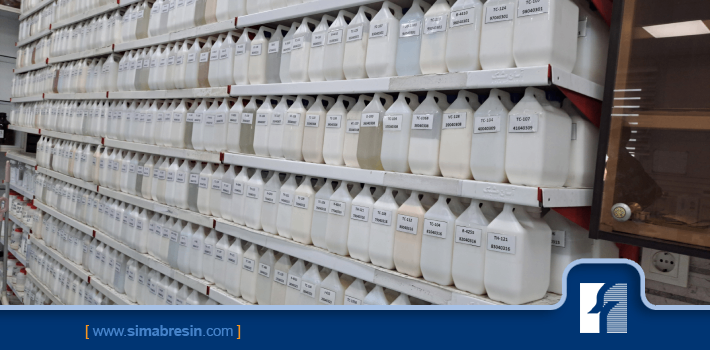
Quality assurance of resin does not only begin with raw materials, but is continuous throughout all stages of production. It is commonplace in a polymer industry to have a complete quality assurance plan that identifies inspection points from raw material receipt to finished goods. Typically, there are three primary stages related to quality assurance in resin manufacture raw material inspection, in-process controls, and final inspection.
During manufacture, it is important to monitor the process conditions (e.g., temperature, pressure, stirring speed, reaction time etc.). Fluctuations, some unwanted, in these conditions can create changes in resin performance. For example, in the case of water-based acrylic resins, it may be quite difficult, but indeed important to keep the same particle size distribution and molecular weight in each batch produced. Variability between batches related to particle size, or molecular weight distribution may lead to poor, or unpredictable performance. Therefore, resin manufacturers often make use of more advanced process control systems (e.g. automatic controllers, PLCs) to ensure the process conditions do not fluctuate beyond defined parameters and prevent quality fluctuations.
Furthermore, by applying statistical methods like Statistical Process Control (SPC), manufacturers can identify small shifts within the production trend and take correction actions to avoid larger quality issues. Sampling points are established throughout the production process (for example after mixing, after polymerization and before packaging), and control tests are performed at each point to assure the resin being produced is within the appropriate specifications. If the control limits are exceeded, the production process is halted or modified accordingly to avoid production of off-specification material.
This methodology minimizes variations in quality, minimizes production waste, and increases the reliability of the resin product thereby affecting customer satisfaction.
Methods and Indicators of Resin Quality Control
In order to monitor the quality of industrial resins (water-based acrylic resins in particular), a small set of relevant quality attributes that can be measured continuously, are worked into a schedule. The most significant attributes are – particle size distribution, viscosity stability, pH, and polymer dispersion uniformity. The measurement of particle size distribution is particularly critical because water-based emulsion resins need to remain within a specific range to maintain the predictable product attributes of clarity, gloss, and film performance. Conventional methods of measuring particle size, such as laser diffraction or dynamic light scattering will provide reliable data on overall particle uniformity and a better understanding of the potential for particle aggregation. The viscosity and rheological behavior of the resin is also measured over a range of shear rates to assess how the resin behaves under diverse processing conditions (pumping, mixing, or also applying it to a surface). In addition, viscosity stability is measured to ensure the resin will not gel or more to more viscous state during storage.
Another important category of tests is stability testing, or simulation of storage and transportation conditions. During stability tests, resin samples are subjected to different thermal cycles (e.g., freeze–thaw, repeated, etc.) or higher temperatures (e.g., typically 40–60°C for accelerated aging conditions) and key properties of the resins are measured at regular intervals. The stability test results provide an indication of how long the resins can be shelf-stored and whether there will be changes in quality during extreme transportation conditions (e.g. in the extreme cold of winter or extreme heat of summer): sedimentation, coagulation, and viscosity, etc.
It is also important to measure how well the finished product performed after it was produced. At this stage the resin is usually cast in the form of a film or solid specimen, and the physical and chemical properties of the resin are measured to determine if they meet functional requirements. For example, the minimum film-formation temperature (MFFT) of water-based coating resins is determined in order to find the temperature at which the resin can form a continuous film. Film hardness is measured to evaluate (König pendulum hardness or pencil hardness), and coating adhesion is evaluated using tests such as cross-cut or pull-off. A water-resistance test is performed by placing a drop of water on the resin film or immersing a film or specimen in water and then observing for a period of time to assess resistance in a humid environment. Evaluating chemical resistance of the resin is completed by exposing cured resin samples to different corrosive (acids, bases, solvents, etc.) materials for a period of time, then evaluating for visual changes or loss of properties. All of these standardized tests (ASTM, ISO etc.) have value providing information about the performance of resin under real-world conditions.
One additional salient point for resin quality control is that as part of continuous monitoring for a process, an increasing number of manufacturers leverage statistical and automated methods for statistical feedback, similar to Statistical Process Control (SPC). As noted above, SPC allows resin manufacturers to detect small deviations in critical production parameters through the use of control charts and statistical indices. Similar to charts for viscosity or particle size for each production batch, control charts indicate whether the resin processes remain in an acceptable range. If production results approach warning limits, the manufacturer will be able to take early corrective action – i.e. temperature, time, concentration, etc. A growing number of high-end resin manufacturers are able to utilize online monitoring systems to measure certain property responses during the resin production process, in a real-time manner. In this instance, when a quality parameter (ex., pH, solids content, etc.) deviates outside of allowable thresholds, alerts are set off, and even corrective action can be taken to adjust or halt the ongoing production process.
In addition to in-plant testing, some manufacturers also perform standardized mechanical tests of selected samples from each resin batch under harsh environmental conditions to simulate product durability and stability. For example, along with mechanical testing (tensile, flexural, etc.) of pure resin or resin used in composite materials, environmental testing is conducted (exposure to moisture, extreme temperature or salt spray, etc.). These tests demonstrate how the resin would perform long-term and in varying applications, and whether it performs to industrial standards amid real-world conditions.
Quality Assurance and Customer Trust
Successfully implementing quality control in the resins arena extends beyond the technical arena, it is a strategic investment in providing customer satisfaction and trust. A resin manufacturer that consistently delivers products with consistent quality and with the quality it promised strengthens its brand and earns customer trust over the long game. However, any deviation from quality can have significant and permanent ramifications, loss of a loyal customer base, or expensive costs discounted from the defective product being recalled from the market. Research shows that in today’s competitive environment, poor quality will damage a company’s reputation and also it will lose market share will happen “quicker than you can imagine”. Quality assurance is essential not only to technical quality, but quality assurance is also to meet and manage customer expectations relative to the product and maintain their trust.

Companies that maintain a formal quality control system and perform quality control checks at all stages (from procurement of raw materials to production and final tests) tend to have reduced defect rates and improved product reliability, increasing customer satisfaction and creating brand advocates. More specifically, an organized quality control procedure is the only effective means of delivering reliable products to markets and maintaining brand integrity in the process. When a customer has experience with a product (industrial acrylic resin) that always performs to expectations and meets the claim, trust is generated, and this becomes the basis for repurchase and recommendation.
In the end, investing in quality systems and committing to principles of quality is not a cost, it is an investment in the long game to ensure future success in the resin market, and customer confidence and trust.
Frequently Asked Questions (FAQ)
- What is the most critical quality parameter in water-based acrylic resin production?
In water-based acrylic resins, particle size distribution is often considered the most critical parameter because it directly affects film formation, gloss, transparency, and overall coating performance. Even small deviations in particle size can lead to major differences in final product quality. - How does Statistical Process Control (SPC) contribute to resin quality assurance?
SPC enables manufacturers to monitor key process parameters such as viscosity, pH, and solids content in real-time using control charts. By detecting early trends or deviations, corrective actions can be taken before defects occur, resulting in more consistent production quality and higher customer reliability.
References