

Industrial Foam and Sponge
Foam and sponge adhesive is an important specialty material in today’s furniture and automotive industries because they are most often the adhesives used to bond foam parts to other components, which in turn occur in foam products. More specifically, these industrial adhesives are designed to bond soft foams, sponges, and impact-absorbing pads, in a way where it provides a sufficient adhesive bond to create a strong, flexible joint without damaging the foam’s cellular structure. When an effective bond occurs, it provides durability, comfort and structural integrity to many products in existing functional uses such as household furniture and car seats. The following describes the important function of these adhesives in furniture and automotive industries, and their main technical attributes.
Applications in the Furniture Industry
In furniture production and semi-related industries such as foam adhesives or sponge adhesives are commonly used to bond a foam layer to a structural or upholstery component. For example, in the case of sofas, foam and sponge adhesives are used to bond polyurethane foams to wooden or metal frames and upholstery fabrics, which means that overtime the (seat) (backrest) does not shift. in addition to being strong, the adhesive joint must be flexible so that the foam maintains its softness and comfort. a high percentage of manufacturers of seats and office furniture utilize adhesives for such purposes with an estimated 90% of the office-chair market using adhesives to bond foam to substrates such as wood, metal, plastic, and fabric.
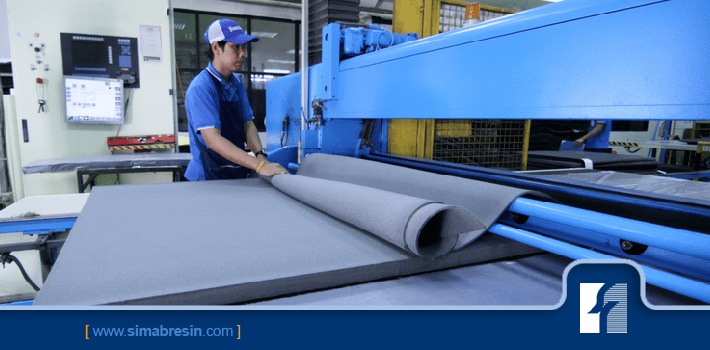
The use of foam and sponge adhesives also results in greater efficiency in the production process. Such adhesives can dry rapidly and, because they have immediate tack, allow for high-speed linear production. The use of spray systems means that large foam surfaces can be coated quickly and uniformly to create a clean bond. In the production of mattresses, for instance, multiple layers of foam are bonded together and to the ticking fabric to hold them in position and create an integrated and durable structure. A further advantage of adhesive is that, compared to stitching or stapling that create stiff points or protrusions, adhesive allows for uniform bonding of foam to other components that results in a consistent surface that is comfortable. The end result is furniture whereby the foam components of the furniture is integrated into the structure of the product and can withstand the continuous use and applied load.
Applications in the Automotive Industry
Foam and sponge adhesives also can be instrumentally important in producing and assembling automotive interior components. There may foam layers bonded with adhesive on interior foams such as car seats, armrests, and trim parts attached to the metal seat frame or the cover options of fabric and leather. On the headliner, a foam layer is attached to the fabric liner of the roof; without a functional adhesive, this will sag or separate over time or in heat. Industrial adhesives with high heat resistance are generally appropriate for these applications, as encountered assembly areas can reach extreme temperature ranges in an automotive environment. Many formulations can maintain their bond integrity at sustained temperatures above 100 °C, amongst the choices, one study witnessed a water-based latex adhesive continuing under the load (>130 °C) without debonding.
Yet another advantage of adhesive joints in vehicles is the ability to dampen vibrations and stresses. As flexible adhesives, adhesives act as shock displacers that prevent foam components from dislodging or rattling due to vehicle movements. Adhesives that are typically used for this would be polychloroprene-latex based, as they provide a fast initial grab, do not travel into the foam structure, and exhibit high tensile and stress resistance. Not to mention, if adhesives were to replace metal fasteners or sewing-like methods, it can also help with weight savings of vehicle interior parts and eliminate unwanted noises in the vehicle. Overall, foam and sponge adhesives may be a hidden but influential component in the automotive marketplace; it is just that the quality and longevity of the interior components will rely on such adhesives to perform properly.
Types and Technical Features of Foam and Sponge Adhesives
Solvent-Based Adhesives: These adhesives utilize polymers dissolved in organic solvents (ex: chloroprene dissolved in either chlorinated or hydrocarbon solvents). Once sprayed or applied, these adhesives evaporate fairly rapidly leaving a tacky layer with an immediate grab. While their advantages include very high adhesion strength due to the polymer and relatively fast drying times, they have been an adhesive of choice for bonding foams for decades. However, the volatile nature of the solvents creates issues of strong odor, flammability concerns, and environmental risks.
Water-Based Adhesives (Latex Dispersions):The polymers in adhesives include polychloroprene, polyurethane and others in low amounts dispersed in water as fine particles. Water-based adhesives utilize no toxic solvents and produce much lower emissions of volatile organic compounds (VOCs). The first (natural latex-based) adhesives were slower drying than solvent types and had to be mixed with a second component (adhesive and hardener), but today we have immensely improved one-component products by using synthetic polymers that have enhanced setting speed and bond strength. Many furniture manufacturers adopted these adhesives especially in regions with stringent environmental regulations. The use of low-odour adhesives protects the health of workers during production and improves indoor air quality of the finished product. Furthermore, there have been attempts by academics and industry scientists in producing environmentally-compatible polyurethane adhesives from natural resources (vegetable oils for example) to provide greener alternatives to conventional adhesives. Water-based latex adhesives provide the necessary bond strength but as they have high suppleness, do not penetrate the foam matrix and thus the foam surface stays soft.
Hot-Melt Adhesives: These adhesives are 100% solids, and must be heated in order for them to melt and flow. Hot-melt adhesives are usually based on thermoplastic resins or polyurethane-that are applied at around 130–150 °C using hot-glue guns or hot-spray systems; after cooling, within seconds, they will solidify to establish a bond, making them extremely desirable for high-speed environments. Because of this property and the fact they contain no solvents means zero VOC emissions and no need for evaporation time which is useful when you are mass producing products. In the furniture and automotive industries, hot-melt adhesives are used to bond foam in automated processes (for example, applying foam to office chairs, or putting foam into dashboards).
Polyurethane and Two-Component Adhesives: In addition to the above information, some foam bonds require special adhesives with very high strength and durability. A one-component polyurethane adhesive curing with ambient moisture or heat, or a two-component adhesive (based on separate resin and hardener) would then be implemented. While these adhesives have a longer set time than the instant-grab types mentioned above, once cured these adhesives provide a very strong bond that is resistant to water, heat, and chemicals. For instance, in making a bond between a household sponge to a rough scouring pad (the green abrasive layer), polyurethane fast-curing foam adhesives have been able to facilitate consistent bonding of a porous sponge surface to a very abrasive layer. Polyurethane adhesives can also be used for specific durability and resistance needs in industrial applications.
Conclusion
Industrial foam and sponge adhesives act as invisible connectivity agents, vital to the quality, durability, safety and quality of products for the furniture and automotive industries. With their strong but flexible adhesive properties, these adhesives are responsible for the more comfortable, more durable, and more lightweight products we now have available, and with new technologies and an increasingly strict adherence to environmental sustainability requirements, every day these types of adhesives are becoming more effective and safer. There is no question that the future will continue to see these types of adhesives as an important part of the design and manufacture of products for the furniture and automotive industries.
Reference